Africa is growing. Can Sri Lanka rediscover its ambition?
Across the Indian Ocean, growth, technical education and industrial investment are changing the economic landscape. Sri Lanka needs a development strategy that connects its maritime position with the capacity to produce knowledge, technology and skilled services.
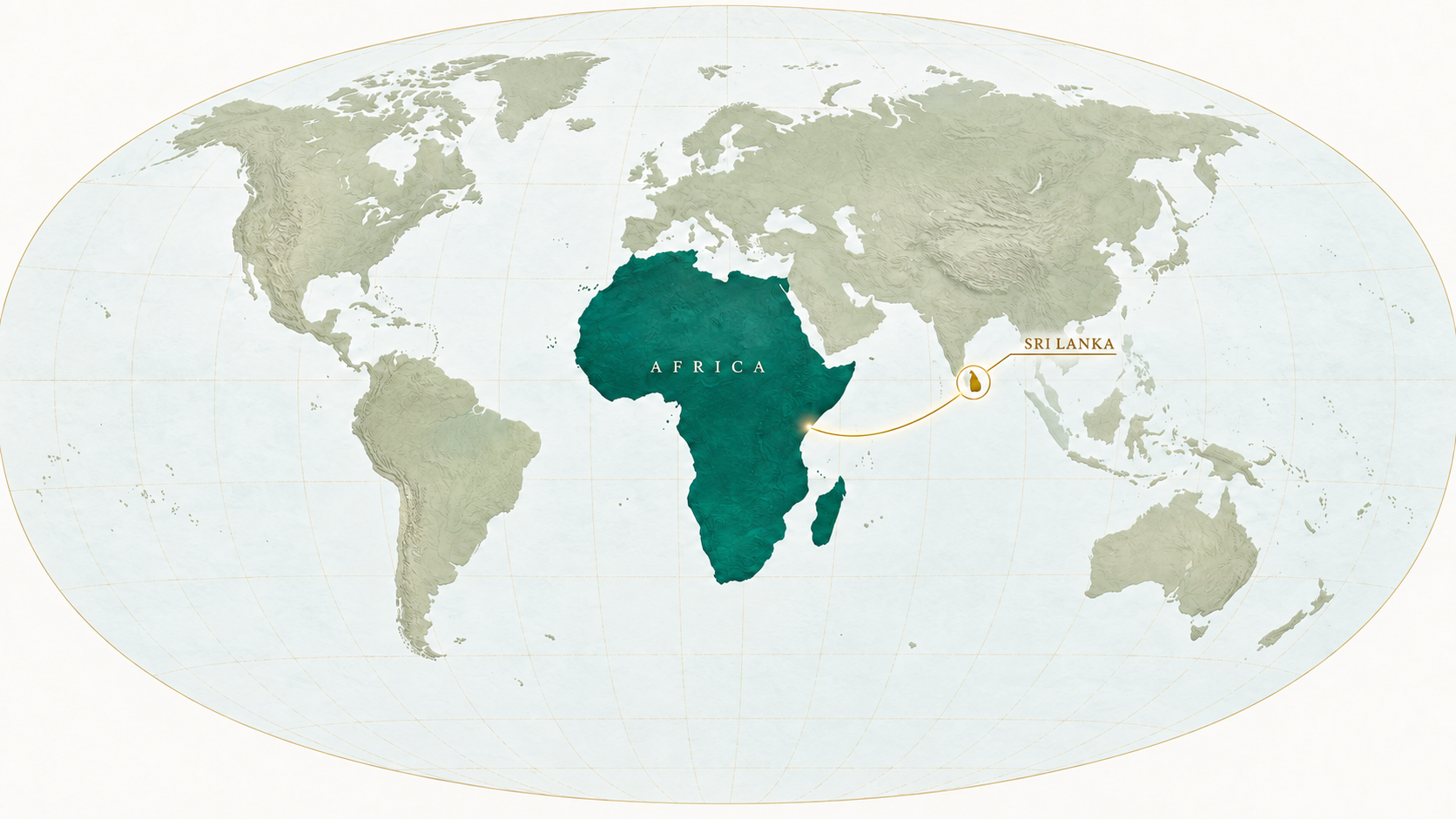
On 4 September 2026, the United Nations General Assembly endorsed an African-led proposal promoting maps that represent the relative size of continents more accurately. The vote was 164 in favour and one against. The initiative, led by Togo and the African Union, challenged the familiar Mercator projection and its distortion of continental areas.1 Cartographic representation does not determine economic performance. Nevertheless, the debate offers Sri Lanka a useful starting point: our understanding of the economies across the Indian Ocean also needs updating.
Africa cannot be reduced to a single development trajectory. Its countries differ substantially in income, institutions, conflict exposure and productive structure. Yet evidence from Eastern Africa warrants attention. In July 2026, the UN Economic Commission for Africa projected regional growth of approximately 5.8% for the year, against 4.0% for Africa overall. Its assessment also identified weak manufacturing performance, constrained public budgets and substantial social-development difficulties.2 The relevant lesson is therefore neither an uncomplicated African success story nor an argument that Sri Lanka has fallen behind every comparator. It is that selected economies are building capabilities which Sri Lanka should understand, engage with and measure against its own progress.
Recovery and relative performance
Sri Lanka's recovery is real. The IMF's May 2026 review recorded real GDP growth of 5.0% in 2025, while projecting 3.0% in 2026 and 3.2% in 2027. It attributed the weaker near-term outlook partly to the Middle East war and its effects on energy costs, tourism and external balances.3 A comparison with Eastern Africa must therefore acknowledge different shocks as well as different economic structures. These forecasts come from separate institutions and publication dates; they are signals of contrasting outlooks, not a controlled test of government performance.
The distinction between recovery and transformation nevertheless matters. The World Bank reports that poverty remains above its pre-crisis level and real wages below 2019 levels.4 Expanding output does not automatically restore household purchasing power, improve job quality or strengthen the capacity to withstand another shock. Sri Lanka's stated medium-term growth ambition is 7%, a target supported by its new World Bank partnership framework; that target should not be confused with a forecast.5
Sustained growth differentials can change relative economic weight even when both economies expand. As an illustration, an economy growing at 6% annually becomes about 79% larger over ten years, while one growing at 3% becomes about 34% larger. These are compound-growth calculations, not country forecasts. Population growth, starting incomes and the distribution of gains also matter: faster aggregate GDP growth alone does not establish faster improvement in living standards.
| Indicator | Sri Lanka | Comparator | Interpretation |
|---|---|---|---|
| Real GDP growth forecast, 2026 | 3.0% | Eastern Africa: approximately 5.8% | IMF, May 2026; ECA, July 2026. Different forecast vintages and geographic coverage.2,3 |
| Container throughput, 2025 | Colombo: 8.29 million TEUs | Singapore: 44.66 million TEUs | Same year and unit; throughput is not a measure of domestic value added.6,7 |
| THE World University Rankings, 2026 | University of Colombo: 1001–1200 | Makerere University: 801–1000 | Institutional rank bands, not national education-system scores.9,10 |
From a port to a wider services economy
Colombo demonstrates that Sri Lanka has already converted part of its location into productive activity. The Sri Lanka Ports Authority reports throughput of 8,291,178 twenty-foot equivalent units, or TEUs, in 2025, its highest annual total.6 Describing the country as a complete failure in maritime logistics would disregard that achievement. The more useful policy question concerns the services, investment and skills that can develop around the port.
Singapore handled 44.66 million TEUs in the same year and, according to its Maritime and Port Authority, hosts more than 200 international shipping groups.7 Dubai illustrates another form of connectivity: its airport operator reports 95.2 million passengers at Dubai International in 2025.8 Container movements and passengers are distinct measures and should not be combined into a competitive ranking. Together, however, these examples show the scale of activity that transport infrastructure can support when connected to commercial services and international networks.
For Sri Lanka, the practical agenda is to increase the value retained around existing trade flows. Maritime engineering, vessel maintenance, logistics software, arbitration and professional services offer areas for assessment. Each requires dependable regulation, suitable skills and evidence of customer demand. An additional terminal or an ambitious investment announcement is insufficient on its own. Policy should track service-export earnings, skilled employment and supplier participation alongside cargo volumes.
Knowledge production and technical education
University comparisons require similar discipline. In the Times Higher Education World University Rankings 2026, Colombo appears in the 1001–1200 band and Uganda's Makerere in the 801–1000 band.9,10 These figures challenge complacency, but a single year's ranking cannot establish that an entire national system is declining. THE's methodology evaluates research-intensive universities through indicators spanning teaching, research, international outlook and industry engagement; it is not a comprehensive measure of educational access or social contribution.11
The policy implication is to examine the conditions for research and advanced training. Sri Lanka should measure doctoral completion, research collaboration, usable laboratory capacity and industry-funded projects over time. Funding should support a limited number of credible research programmes with transparent evaluation, while technical colleges provide complementary practical skills. Progress in one institution should not depend on weakening broad access to education.
Kenya provides a more concrete example of expansion in technical training. Its Ministry of Education reports that enrolment in public TVET institutions under its oversight increased from 345,387 in 2022/23 to 565,842 in 2024/25, a rise of 63.8%. The separate count of public and private TVET institutions increased from 2,401 to 2,969.12 These measures cover different institutional populations. Neither should be compared directly with a single Sri Lankan agency's learner count. Moreover, enrolment growth is an input; completion, competence, employment and earnings determine its eventual value.
Sri Lanka's Cabinet briefing of 24 August 2026 records approval of a TVET framework for 2026–2035 and acknowledges a mismatch between training content and labour-market requirements.13 Implementation should begin with employer-linked programmes in fields such as industrial maintenance, mechatronics, energy systems, marine technology and biomedical-equipment servicing. Paid placements, shared equipment and published graduate outcomes would provide more useful evidence of reform than course launches alone. Technical education also needs pathways into further study, so that choosing an applied qualification does not close future opportunities.
An Indian Ocean economic strategy
Africa should also feature in Sri Lanka's external economic planning. In August 2026, the East African Community described its market as exceeding 331 million people, with combined GDP of approximately US$357 billion.14 The EAC is an institutional grouping, distinct from the broader Eastern Africa region used in ECA's growth estimates. Market size creates possibilities for partnerships, but trade barriers, purchasing power, transport costs and payment risks determine which are commercially viable.
Energy offers one example requiring careful assessment. TotalEnergies announced the full restart of Mozambique LNG activities in January 2026 following the project's suspension. The operator reported construction progress of 40% and expected first LNG in 2029.15 That date is a project expectation, not evidence of current supply. Mozambique's experience also illustrates how security conditions and construction delays can affect an apparently attractive resource opportunity.
Sri Lanka could evaluate African LNG suppliers as part of a diversified procurement strategy where gas is justified by power-system requirements. Such an assessment must compare delivered costs, foreign-exchange exposure and contractual obligations with renewable generation, storage and other flexibility options. The existence of gas across the ocean is not sufficient justification for a terminal or a long-term purchase commitment. The wider objective is to develop commercially grounded relationships in energy, logistics, education and professional services.
What India's industrial expansion suggests
India's expansion under Narendra Modi provides a nearby example of sustained attention to industrial scale. Government figures put electronics production at approximately ₹13.11 lakh crore in 2025–26, compared with ₹1.9 lakh crore in 2014–15—about a sevenfold increase in nominal rupee terms.16 This is a production-value comparison, not an inflation-adjusted measure of output or a direct estimate of domestic value added. It also cannot, by itself, establish the contribution of any individual leader or policy.
The useful question for Sri Lanka is how investment, supplier development, technical training and access to markets can reinforce one another. A smaller economy should choose areas where it can compete or supply larger production networks. Electronics services, specialised engineering and digitally delivered professional work deserve evaluation against actual capabilities and demand. Policy continuity matters, but so do competition, open assessment of incentives and the ability to end programmes that fail to deliver public value.
AI and robotics as productive capabilities
The next technological transition makes this educational and industrial agenda more urgent. EAC ministers adopted an AI declaration in April 2026 that included a commitment to establish a regional AI technologies fund.17 A declaration is not evidence of a functioning fund or improved productivity. It does, however, show that regional economic planning increasingly includes the ability to develop and adapt technology.
Sri Lanka should judge AI and robotics by measurable improvements in work. The ILO's 2025 assessment estimates that one in four workers globally is in an occupation with some exposure to generative AI, while emphasising that task transformation is more likely than complete job replacement.18 Exposure is not a forecast of job losses, and global estimates should not be presented as Sri Lankan labour-market findings.
Practical pilots could address document processing in logistics, preventive maintenance in factories and repetitive administrative work in public services. Each should publish its baseline, costs, error rates and results. Where systems handle personal information or consequential decisions, accountable staff must retain appropriate oversight. Training must accompany deployment, including opportunities for workers whose tasks change. Universities can support evaluation and adaptation; technical colleges can train the people who install and maintain equipment.
Sri Lanka does not need another catalogue of unrelated national ambitions. It needs a small number of connected programmes, responsible institutions and indicators that survive electoral cycles. A first phase could link port-related services with employer-designed technical training, competitively selected university partnerships and independently evaluated automation projects. Expansion should follow demonstrated results and fit within a credible fiscal framework.
The map debate concerns how the world represents Africa. Sri Lanka's development challenge concerns what it makes of its own position. Its neighbours and partners are changing, while geography alone confers no guarantee of prosperity. The next advance will depend on the skills, institutions and productive relationships that make this location economically consequential.
References & notes
Sources checked 9 September 2026. This commentary uses selected public sources; it is not a systematic review or original empirical study.
- United Nations, Office of the Special Adviser on Africa. Victory for Africa as UN Votes on Resolution to “Correct the Map”. 8 September 2026.
- UN Economic Commission for Africa. ECA launches 2026 Eastern Africa Macroeconomic and Social Overview Report. 23 July 2026.
- International Monetary Fund. Executive Board completes the combined fifth and sixth reviews under the Extended Fund Facility for Sri Lanka. 27 May 2026.
- World Bank. Sri Lanka country overview, Economy section. Accessed 9 September 2026.
- World Bank. Sri Lanka and World Bank Group launch new partnership to create jobs, attract private investment. 2 April 2026.
- Sri Lanka Ports Authority. Port of Colombo records historic high of 8.29 million TEUs in 2025. 1 January 2026.
- Maritime and Port Authority of Singapore. Singapore retains position as world's leading maritime centre for 13th consecutive year. 2026.
- Dubai Airports. Dubai Airports Fact File, 2025 traffic figures. Accessed 9 September 2026.
- Times Higher Education. University of Colombo: World University Rankings 2026.
- Times Higher Education. Makerere University: World University Rankings 2026.
- Times Higher Education. World University Rankings 2026: methodology.
- Kenya Ministry of Education. TVET Sub-Sector Report for FY 2026/27 to FY 2028/29. October 2025, performance review.
- Sri Lanka Cabinet Office. Strategic Framework for the Technical and Vocational Education & Training Sector 2026–2035; Skills Development System Transformation Programme. Cabinet briefing, 24 August 2026.
- East African Community. EAC Secretary General calls for stronger public-private partnership to boost regional competitiveness and intra-EAC trade. August 2026.
- TotalEnergies. Mozambique LNG announces the full restart of all its activities onshore and offshore in Mozambique. 29 January 2026. Project-operator statement.
- Government of India, Press Information Bureau. Electronics production grows seven-fold to over ₹13 lakh crore. 29 July 2026.
- East African Community. EAC adopts AI declaration resolving to establish regional AI fund and prioritise AI sovereignty. 9 April 2026.
- International Labour Organization. Generative AI and jobs: A 2025 update. 20 May 2025.
AI assistance: ChatGPT/Codex assisted with research, source checking, drafting and language editing.
Explore the argument.
Ask for an explanation, a comparison or the limits of the evidence. The guide uses this article and its source notes; it does not open the linked sources.
Checking membership…
Discuss the article
Which idea deserves further discussion, and what evidence would help evaluate it?
Checking membership…
No comments yet. Start a thoughtful discussion.